


AI Generation este un curriculum pentru liceeni ce vizează dezvoltarea literației în domeniul inteligenței artificiale (IA), creat de UiPath Foundation în parteneriat cu App Inventor Foundation, o inițiativă a Massachusetts Institute of Technology (MIT). Acesta constă în două cursuri și urmărește nivelul de progres al Cadrului de competențe IA pentru elevi dezvoltat de UNESCO: înțelege, aplică și creează.
UiPath Foundation a lansat curriculumul în cadrul programului său Caleidoscop, cu o cohortă de 94 de liceeni, cărora le-au predat voluntari din compania UiPath, din diferite departamente tehnice și non-tehnice. La finalul cursurilor, 97% dintre liceeni au spus că au învățat ceva nou, iar 80% dintre ei își doresc să urmeze o carieră în IA.
Petruța
Petruța, profesor limba și literatura română
Sunt reticentă la tehnologie, dar acest curs mi-a deschis drumul spre instrumente pe care le pot folosi în orice moment al lecției. Îl recomand tuturor profesorilor care își doresc momente atractive în timpul lecțiilor, dar și realizarea multor materiale într-un timp scurt.
Sorin
Cursant și elev în clasa a XI-a
Mi-a plăcut foarte mult faptul că modul în care a fost prezentat acest fenomen de IA a fost unul ușor de înțeles, fără limbaje foarte complicate sau scheme imposibil de urmărit. Cursurile au avut o înlănțuire logică si, cu puțin interes, am putut discuta despre bazele a ceea ce este inteligența artificială.
Curriculumul AI Generation este o resursă recomandată de către Ministerul Educației și Cercetării în programele școlare pentru discipline din filiera teoretică, dar și cea vocațională în anul școlar 2026-2027.
AI Generation a ajuns la:
elevi din programul Caleidoscop și în licee
profesori care au accesat materialele de curs
licee în 11 județe
Pasul 1
Transmiteți un mail către aigeneration@uipathfoundation.com în care să includeți: numele și adresa liceului, adresa de e-mail și numărul de telefon al persoanei de contact și varianta de colaborare dorită.
Echipa va lua legătura cu liceul în scurt timp pentru semnarea unui acord de colaborare.
Pasul 2
Începem colaborarea, care va presupune implicarea profesorului care va preda materia, prin:


Pasul 3
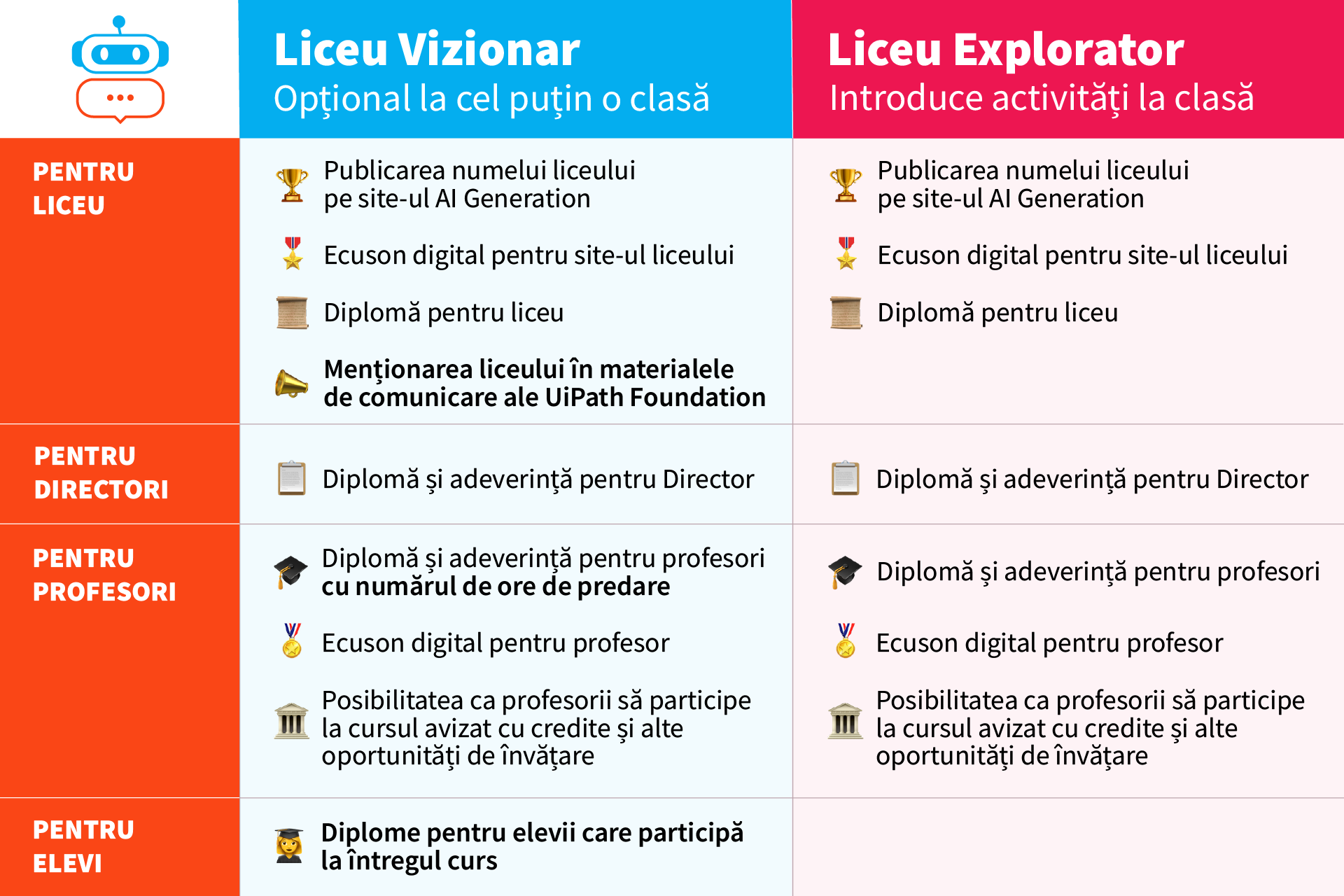
Acordarea beneficiilor se face în funcție de forma de colaborare aleasă, după semnarea acordului și odată cu începerea implementării.
Diplomele și adeverințele se acordă la finalul anului școlar în baza raportării către UiPath Foundation.
În 2025 am dezvoltat un curs pentru profesori complementar curriculumului AI Generation, care să îi pregătească pe aceștia pentru a preda curriculumul la clasă.
Acesta este avizat ca program complementar de către Ministerul Educației și Cercetării și echivalat cu 2 credite ECTS.
Cursul le oferă profesorilor informații despre cum să aleagă și să folosească instrumentele IA care sprijină procesul de predare și evaluare, adaptându-le nevoilor elevilor.
În 2026, 75 de profesori vor dobândi competențe reale de integrare a IA la clasă în cadrul proiectului AI Ready Teachers, derulat în parteneriat cu ING România.
Cursul îi introduce pe liceeni în lumea inteligenței artificiale și le construiește fundamentele pentru literația în inteligența artificială.
Este un curs non-tehnic, cu lecții interactive care introduc concepte treptat, ceea ce îl face accesibil elevilor de liceu, indiferent de profilul liceului sau al clasei.
Elevii învață despre IA și despre cum este deja folosită în întreaga lume. Ei explorează instrumentele și platformele IA și participă activ în discuții etice colaborative și proiecte de grup axate pe utilizarea IA.
Acest curs se concentrează pe descoperirea inteligenței artificiale și nu implică programare.
Componentele AI Generation
Curriculum pentru liceeni „Introducere în inteligența artificială”
Curriculumul este creat de UiPath Foundation în parteneriat cu App Inventor Foundation, o inițiativă a Massachusetts Institute of Technology (MIT). Acesta constă în două cursuri și urmărește nivelul de progres al Cadrului de competențe IA pentru elevi dezvoltat de UNESCO: înțelege, aplică și creează.
Cursul pentru profesori „Instrumente, etică și predare asistată de IA”
Cursul este avizat ca program complementar de către Ministerul Educației și Cercetării și echivalat cu 2 credite ECTS, oferă profesorilor o călătorie prietenoasă și accesibilă în universul inteligenței artificiale, începând cu explicarea conceptelor de bază și continuând cu o abordare responsabilă și etica IA.
Curriculumul AI Generation este o resursă recomandată în programele școlare:
- Tehnologia informației și a comunicațiilor (TIC), Trunchi Comun, clasele a X-a, a XI-a, a XII-a
- Informatică, Curriculum de specialitate (CS), clasa a XII-a:
-Filiera teoretică, profilul real, specializarea matematică-informatică, clase cu predarea disciplinei informatică în regim intensiv
-Filiera teoretică, profilul real, specializarea matematică-informatică Filiera vocațională, profilul militar, specializarea matematică-informatică militară
Curriculumul AI Generation a ajuns:
- La peste 800 de elevi din programul Caleidoscop și în licee
- În 17 de licee din 11 județe
- La peste 600 de profesori care au accesat materialele de curs
The course introduces artificial intelligence to high school students and builds the foundation for AI literacy.
It’s a non-technical course, with interactive lessons, gradually introducing concepts, which makes it accessible to students regardless of their prior knowledge or experience with AI.
Students learn about AI and how it’s already being used worldwide. They explore AI tools and platforms and engage in highly collaborative ethical discussions around the use of AI.
This course focuses on discovering AI and doesn’t involve programming.
Course Structure
Curriculumul AI Generation a ajuns:
Alongside the course, we’ll provide teaching materials, such as:


Module 1
The first module introduces students to the world of Artificial Intelligence exploring examples of technology, learning about simple algorithms and decision trees and delving into the ethical principles of AI.
Keywords: data, algorithm, intelligent result, human agency, human oversight, ethical principles and bias, real-life scenarios, discussions, group work, presentations, constructive feedback.
Module 2
In the second module, students will use generative AI tools to create images and text while working in group projects. They will critically evaluate AI features used by popular digital platforms and understand their purposes and intentions by using the Ethical Stakeholders Matrix.
Keywords: chatbots, generative AI, image generation, copyright and intellectual property, security and privacy, AI-generated content, Ethical Stakeholders Matrix.
Module 3
During the third module, students will continue their learning by applying ethics to their analysis of a popular shopping platform, exploring Deep Fakes, reviewing and designing AI public policies and a child-care robot.
Keywords: Deep Fakes, AI system design, AI citizenship, public policies, environmental implications, designing a child-care robot, ethics by design
Module 4
Module 4 concludes the course with a finale exam and followed by a series of sessions where students work on their group project, designing a learning experience on AI for their community.
Keywords: brainstorming, teamwork, planning, design, feedback, presentation.
Are you an educator who…
- Has prior teaching experience
- Is open and curious about AI, no Computer Science or IT&C background necessary
- Is comfortable using materials in English


In class, if:
- You are familiar with computers and using digital tools (e.g. collaborative tools, Google Workspace, YouTube, Microsoft Office).
- You have a computer and, ideally, a video projector in the classroom.
- You have internet access in the classroom.
- Your students have access to computers, tablets, smartphones, ideally one per student.
Online, if:
- You are familiar with computers and using digital tools (e.g. collaborative tools, Google Workspace, YouTube, Microsoft Office, video conference tools).
- You have a computer or laptop with a webcam.
- Your students have devices such as laptops or tablets, but smartphones are also acceptable.
- You and your students have a stable internet connection.
The course is designed to be highly interactive and collaborative. The lessons involve free discussions, debates, teamwork, practical projects using AI tools, and creating a learning experience for the community as a final group project in Module 4.
Through these activities, students also have the opportunity to develop their cognitive and socio-emotional skills regarding: communication, collaboration, negotiation, planning, creativity, presentation skills, critical thinking, problem solving, argumentation skills, etc.
Themes
- What is AI?
- How it works and its basic algorithms
- Industries where it is already used and its impact on society
- What is Generative Artificial Intelligence, and how it works
- How to recognize a Deep Fake and content created by AI
- Ethical aspects of using AI
- How streaming and shopping platforms use AI
- Understanding the impact AI-generated content has on artists and the creative industry
- How to use AI for the benefit of our communities
Learning objectives
- Recognize AI as human-led and understand the importance of human agency and oversight.
- Understand common algorithms and critically analyze AI algorithms used by mainstream platforms.
- Define ethical AI principles and evaluate AI systems based on these principles.
- Assess the purpose and intention of an AI product.
- Collaborate with peers to create artifacts with AI tools for various domains in group projects.
- Evaluate the impact of AI technologies on society, social and cultural norms, and the environment.
Get Your Diploma!

Educators worldwide can apply for a diploma if they have:
- Taught the course to high school students
- Filled out the feedback form received via email upon registration
- Given out the anonymous feedback form to students received via email upon registration
- Sent in proof certifying that they taught the course, signed by their organization’s Director


-
Erdin
10th grade student, Bucharest, RomaniaWhat I liked most was how easy the lessons were to understand, the way the information was explained. I learned about AI’s power consumption and how it actually works! I would highly recommend this course to my friends and I would start by saying that this course really teaches you in a fun way and instead of stealing your energy, it gives you more!
-
Andreea
11th grade student, Vrancea county, RomaniaIf I were to recommend this course to a friend, I would describe it as a course that can help you a lot in the future and also in the present; a course that shows and provides examples of how to figure out if the things we see online are real or just made with the help of AI.
-
Georgeta
11th grade student, Neamț county, RomaniaThanks to this course, I learned the basics of artificial intelligence, what this concept means, what criteria it must respect and it formed a foundation for me in this field. I would describe this course as a foundation, an interactive starting point in the world of AI, which only brings satisfaction and increases curiosity.
-
Sorin
11th grade student, Suceava county, RomaniaI learned that AI is much easier to understand and, surprisingly, very common. I was even asked by a friend what this course is like, and I struggled a little to describe it, because this is something you have to experience to understand the satisfaction it offers. In short, something more unique.

-
Larisa
Senior Customer Success Manager @ UiPathFor me, teaching a course was a new experience. The course content was very well structured, with various materials (theoretical concepts explained in a way that everyone can understand, videos, media, group and individual exercises) which made the teaching process clear, accessible and easy to understand.
I especially enjoyed the students’ curiosity and enthusiasm – their intelligent questions and eagerness to absorb new concepts turned each session into an engaging dialogue.
-
Flori
Senior Legal Counsel @ UiPathAs a Senior Legal Counsel, my main role is to provide legal advice and lead negotiations for international contracts with clients. What I liked most was the fact that the students showed interest in the subject, but also the fact that it was easy to emphasize how important it is to learn about AI, considering that it will influence our lives in all aspects.
We also got a lot of satisfaction from the simple idea that we are preparing ourselves together for some challenges and that we have a valuable advantage over those who don’t do it at all and do not realize the subtle effects of AI in their lives.
-
Antonia
Technical Writer @ UiPathI am a Technical Writer at UiPath, where I explain software solutions to different audiences. The most memorable moments were the interactions with students, open discussions about AI and the debate on the changes taking place in technology. I would describe this course as an eye-opening experience, full of meaningful interactions and funny moments.
-
Izabella
Senior Program Manager @ UiPathWhat impressed me the most was the simplicity with which the concepts are introduced, the interactivity of each lesson, and the activities that engage students in each lesson. The course not only explains AI, but makes it intuitive and engaging, providing a solid foundation from principles to ethics and applicability.
For those who may fear that they do not have enough technological experience, I can tell you that this course is built to be accessible, logical, and effective. It feels like child’s play, but it is at the same time profound and transformational – for both teachers and students.
-
Andreea
Learning Consulting Director @ UiPathI frequently coordinate initiatives related to learning and innovation, so when I was invited to teach this AI course for high school students, I accepted with enthusiasm. Not having a technical background, I wondered if I would be able to provide the students with a valuable experience, but the well-structured, clear and easily adaptable materials turned this challenge into a genuine learning opportunity – not only for them, but also for me.
This course does not require technical expertise, but openness, a desire to learn and the confidence that we can guide young people in a relevant conversation about the future.
The Pilot Project
The Introduction to Artificial Intelligence course was piloted in 2024 with 94 high schoolers aged 15 to 17 from underserved communities across 20 counties in Romania. The students are part of the Own Your Path program.
The course was held online, on the Own Your Path Digital Educational Platform, over 14 weeks, in 90-minute lessons.
The students had internet access through tablets provided in the program.
The trainers were UiPath employees from various non-technical and technical departments who volunteered their time to this project. They were coordinated by volunteer Instructional Designers who adapted the materials and guided their journey.
Monitoring & Evaluation Report:
Introduction to Artificial Intelligence
We gathered information through Knowledge Assessment Quizzes and feedback forms from students, and we have drawn a series of conclusions which we’ve consolidated in a Monitoring & Evaluation Report. Some our findings are as such:
- 97% of students felt they learned something new.
- 80% of students said they were interested in pursuing a career in AI.
- There was an increase in students’ perception of their overall problem-solving skills after the course.
- After taking the course, 88% of students felt that they have the ability to explain Artificial Intelligence concepts to their peers.
Frequently Asked Questions
Who is this course for?
Who can teach this course?
What topics are covered in the course?
Is this course technical? Does it require programming skills?
How long is the course?
How is the course structured?
Is the course free?
Is this course available online or only in classrooms?
What teaching materials are provided?
Do teachers need AI expertise to teach this course?
What are the requirements for teaching in class? And online?
How can teachers receive the teaching diploma?
Who is this course for?
This course is designed for high school students who want to learn about artificial intelligence (AI) in a non-technical way. No prior experience with AI or coding skills are required.
Who can teach this course?
Any educator can teach this course – no programming skills are needed. It is designed for:
- Teachers in formal and informal educational settings
- Teaching assistants
- Trainers and educational coordinators
- Librarians, NGO members, and volunteers
What topics are covered in the course?
The course covers AI fundamentals, how AI is used in different industries, Generative AI, ethical considerations, Deep Fakes, the impact of AI on society and the creative industry. Students will also explore how AI can be used for the benefit of their communities.
Is this course technical? Does it require programming skills?
No, this is a non-technical course. It focuses on understanding basic AI concepts rather than coding.
How long is the course?
The course consists of 36 lessons, each lasting 50 minutes, divided into 4 modules, including a final group project. It can be taught over an academic year at a flexible pace.
How is the course structured?
Module 1: Introduction to AI, simple AI algorithms, and ethical AI principles.
Module 2: Generative AI, AI-generated content, and stakeholder analysis.
Module 3: AI citizenship, AI public policies, Deep Fakes, and AI system design.
Module 4: Group project – creating an AI learning experience for the community.
Is the course free?
Yes! The course is completely free of charge for educators and students.
Is this course available online or only in classrooms?
The course is adaptable for both in-class and online synchronous teaching.
What teaching materials are provided?
- Guide for teachers
- Lesson plans
- Presentations
- Individual and group worksheets
- Additional learning materials (videos, articles)
- Quizzes
Do teachers need AI expertise to teach this course?
No prior AI experience is required. Teachers just need basic English and computer skills, curiosity about AI, and prior teaching experience.
What are the requirements for teaching in class? And online?
In class:
- Teachers’ computer or laptop and video projector (optional)
- Internet access
- Devices with internet access for students (it can be their own mobile phones and they can work in groups on one device).
Online:
- Computer or laptop
- Good internet connection
- Video conferencing tool (Zoom, Google Meet, Microsoft Teams)
- Student devices: preferably laptops or tablets for a good learning experience, but smartphones are also acceptable
How can teachers receive the teaching diploma?
To receive the diploma, educators need to:
- Teach the course to high school students.
- Fill out the teacher feedback form.
- Distribute the anonymous student feedback form.
- Submit a signed document from the organization’s director.
- After review, teachers will receive the diploma via email.
About Our Partners

App Inventor Foundation
Is a 501(c)(3) nonprofit established by professors and engineers from MIT and Google. Its mission is to empower students to create meaningful technologies that can transform their lives and uplift their communities. Since its inception in 2007, the App Inventor project has reached over 20 million learners worldwide, who have collectively built more than 100 million mobile apps. Grounded in the principles of constructionism and computational action, App Inventor emphasizes learning through building real-world solutions that matter to students and their communities. The Foundation collaborates closely with MIT App Inventor to expand global access to computing education through curriculum development, teacher training, and leadership in international K–12 AI education policy.
Obține diploma!
Profesorii și trainerii care predau cursul pot obține o diplomă, dacă:
- Predau întreg cursul
- Completează formularul de feedback primit pe e-mail
- Dau liceenilor formularul de feedback anonim
- Trimit o adeverință semnată și ștampilată de conducerea organizației care să ateste organizarea cursului